
Needlepoint Stitches for Borders
A border frames the design, so it should be steady and even rather than busy. Choose the stitch by the width of the band: small units for a narrow edge, bigger or raised units for a wide or decorative one. Plan the corners before you start.
Square units such as Scotch, mosaic and Rhodes turn a corner cleanly: stop the pattern and fill the corner square with one unit. Diagonal stitches such as Byzantine and Nobuko change direction at a corner, so mitre them along the diagonal or stop and work a corner square. Keep the border quieter than the centre, and see background stitches for the field inside it.
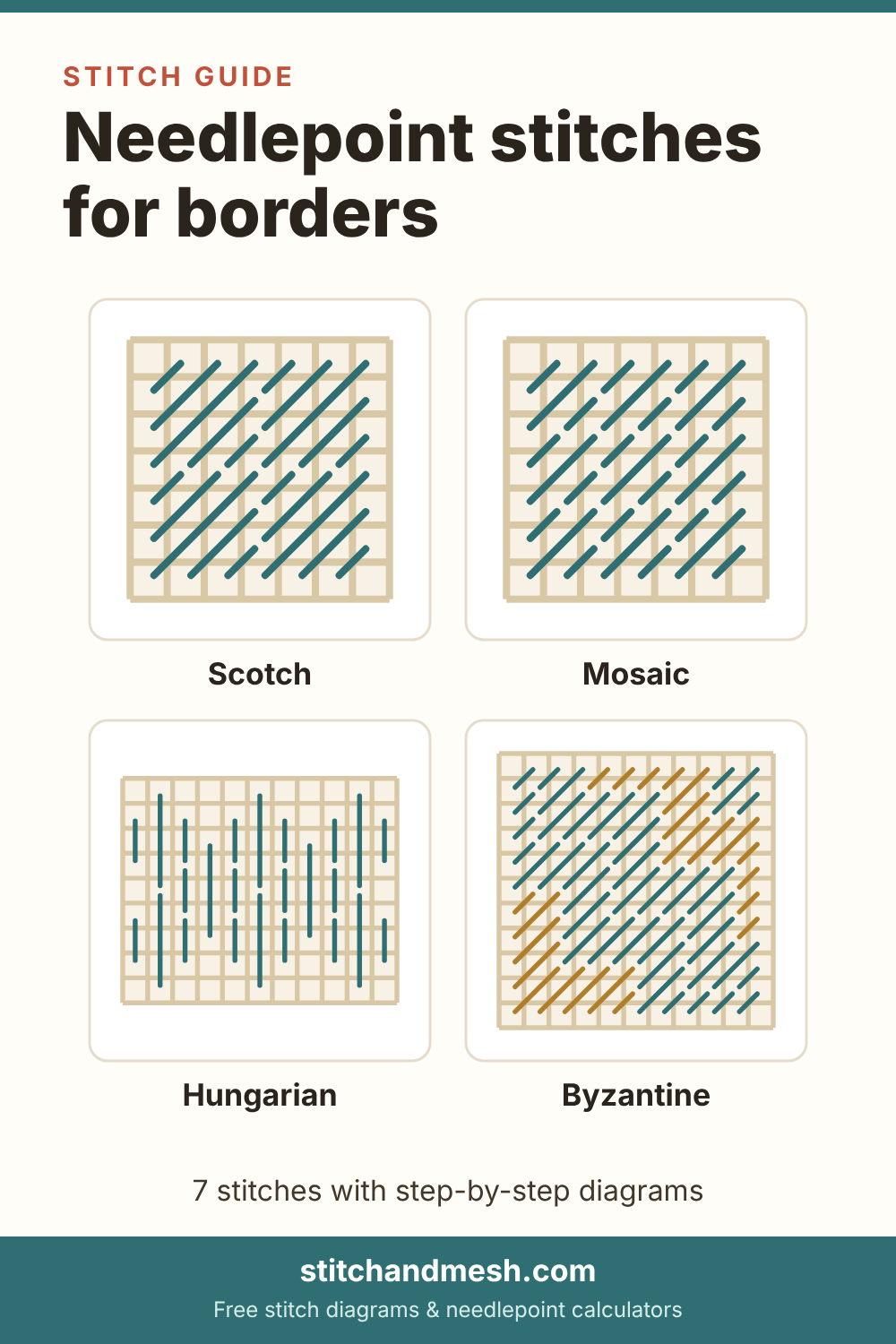
Scotch Stitch
Square blocks fit a band three to five threads wide and turn a corner with a single block. Alternate the slant for a checked edge.
Mosaic Stitch
The smallest box stitch, for a narrow band two or four threads wide, and it stays neat on 18 mesh.
Hungarian Stitch
A small diamond repeat that reads as a woven braid along a straight edge.
Byzantine Stitch
Staircase rows make a bold, wide band. Mitre it at the corners so the steps meet on the diagonal.
Nobuko Stitch
Long and short stitches lock into a fine woven texture, a quiet band that won't compete with the design.
Rhodes Stitch
A raised square for the corners, or repeated along the band for a padded, decorative edge.
Algerian Eye Stitch
A row of eyelets makes a lacy band, and a single eyelet makes a neat corner.
Questions
What is the best needlepoint stitch for a border?
Scotch stitch is the most versatile border stitch: it's quick, it turns corners neatly, and the blocks can alternate slant or colour. Mosaic suits narrow bands, and Rhodes or Algerian eye makes a raised, decorative edge.
More collections: water · sky · grass · brick and stone · fur · snow · lettering · faces and skin · hair · leaves and trees · clothing