
Needlepoint Stitches for Lettering
Letters need clean edges more than texture. Small, smooth stitches keep a monogram readable, and blockier stitches suit big, bold initials. Choose by the height of the letter and the mesh, and keep the thread fine enough that the holes in letters like a, e and o stay open.
A stroke one stitch wide needs tent stitch; textured stitches need strokes at least two or three threads wide, which usually means bigger letters or a lower mesh. 13 vs 18 mesh shows how much detail each canvas holds, and the best thread for 18 mesh helps keep small letters crisp. For one decorative initial, an eyelet such as Algerian eye can work, but not for whole words. New to the two tent methods? Read how to do basketweave, how to do continental and which stitches to learn first.
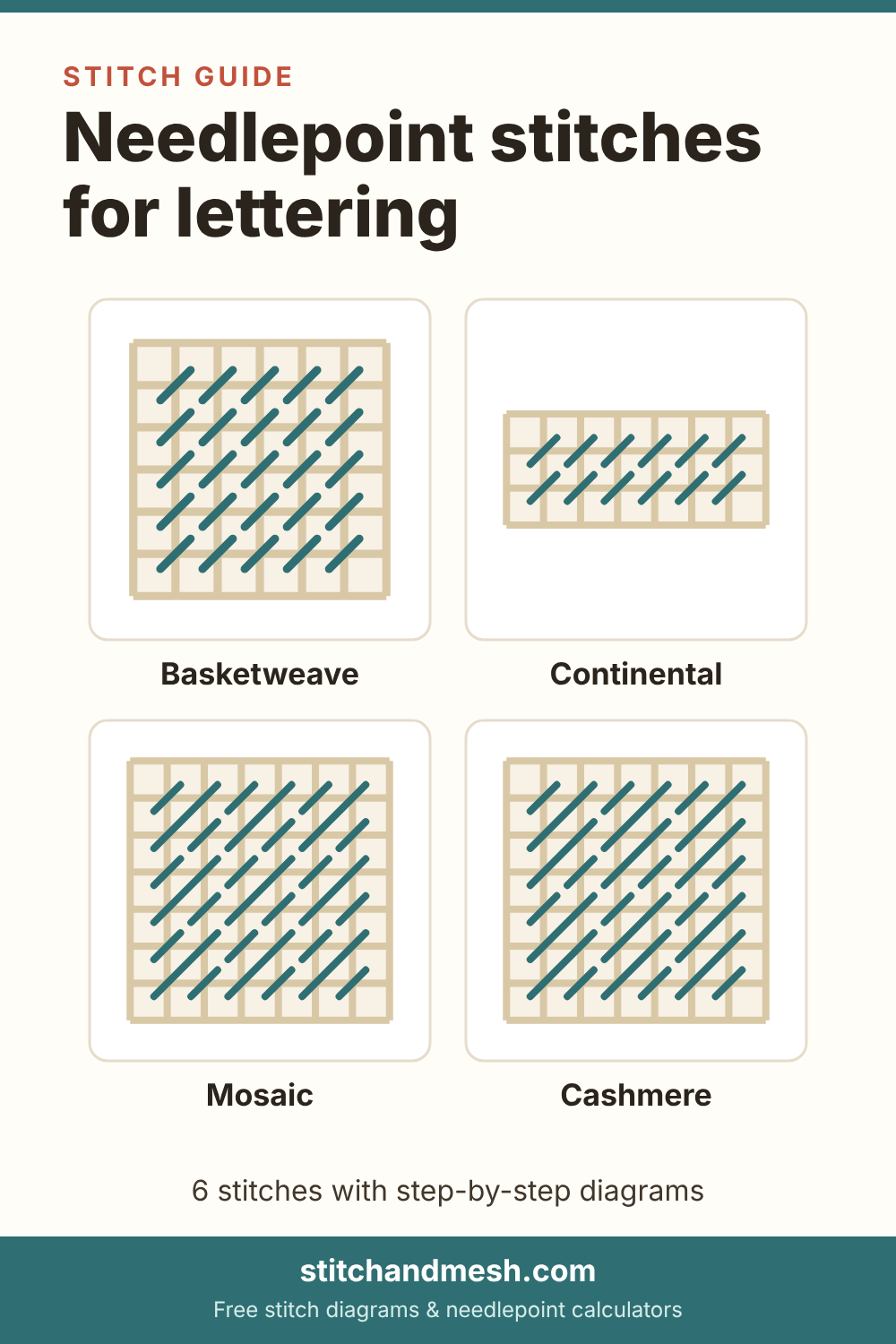
Basketweave Stitch
Smooth, even coverage with a crisp edge on every side, the default for painted monograms and small letters, especially on 18 mesh.
Continental Stitch
Works along a single line, so it handles thin strokes, serifs and tight curves where basketweave's diagonal rows don't fit.
Mosaic Stitch
Small square blocks make low, chunky letters, best when every stroke is at least two threads wide.
Cashmere Stitch
A slightly tall block, so it suits narrow, upright letterforms and gives them a fine woven look.
Upright Gobelin Stitch
Strong vertical strokes for small capitals and block letters. Add a strand if canvas shows where a letter turns.
Cross Stitch
Good for counted alphabets worked from a chart. On a painted canvas it sits higher than the painted edge, so test a letter first.
Questions
What is the best needlepoint stitch for letters?
Basketweave is the best default for painted letters and monograms, with continental for strokes one stitch wide and tight curves. For large block letters, mosaic, cashmere or upright Gobelin give a bolder, more textured letter.
More collections: water · sky · grass · brick and stone · fur · snow · borders · faces and skin · hair · leaves and trees · clothing