
Needlepoint Stitches for Leaves and Trees
A tree full of leaves needs a small, broken texture that suggests many leaves at once, while a single leaf or a trunk needs a stitch with direction. Change greens from row to row to give a tree light and shade.
Lawns, meadows and ground cover are on stitches for grass. Here, single leaves, foliage, trunks and branches. For a trunk, work the stitches in the direction the tree grows.
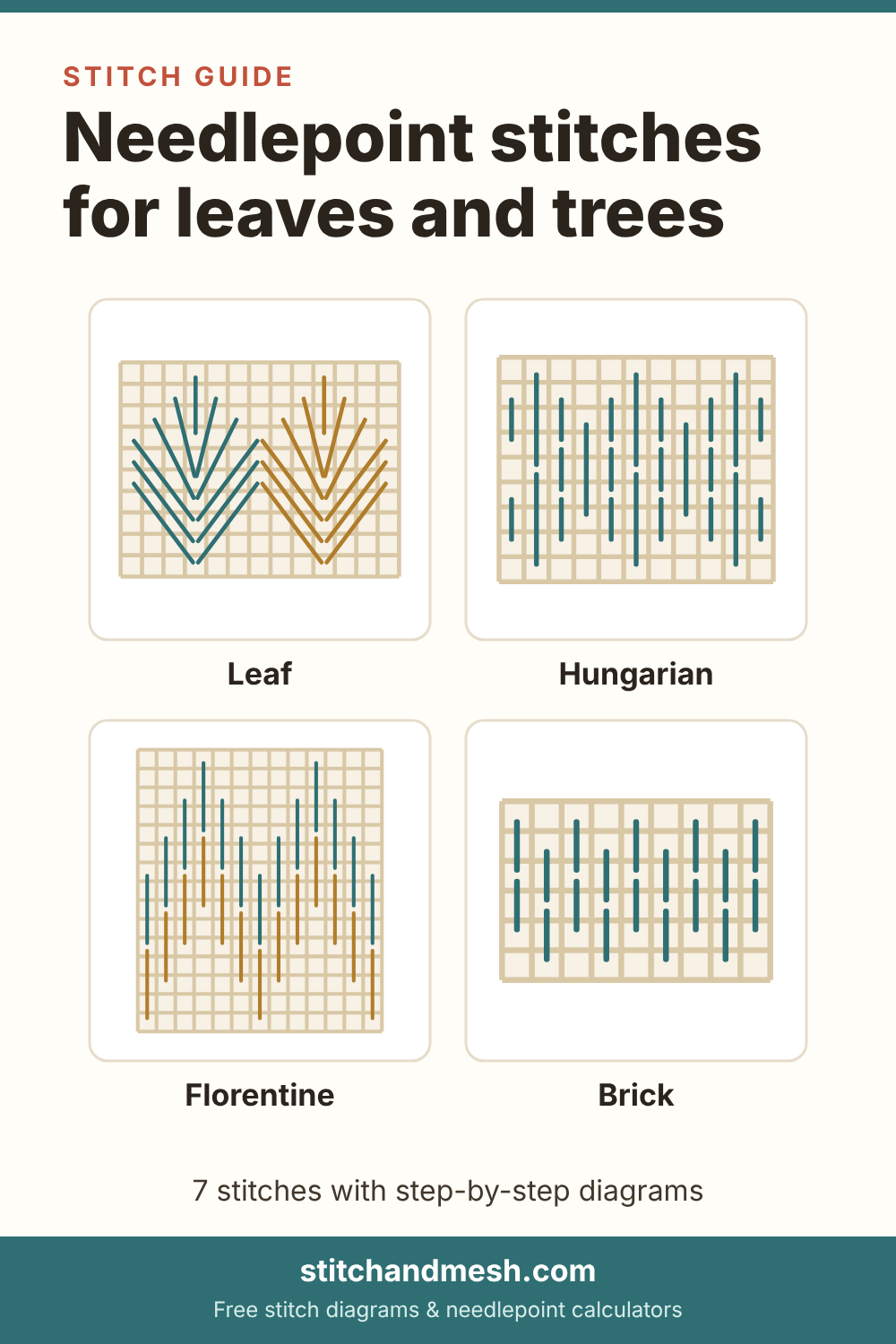
Leaf Stitch
Each unit is a leaf, with a centre vein and a pointed tip. Use it for single leaves, petals and leafy borders.
Hungarian Stitch
A small diamond repeat that reads as a mass of leaves, for hedges, bushes and treetops.
Florentine Stitch
Zigzag rows suggest layered branches or a stylised tree, especially stepped through three greens.
Brick Stitch
Staggered upright stitches give foliage a soft texture and shade easily from row to row.
Nobuko Stitch
A fine woven texture for distant trees and dense foliage, quieter than Hungarian.
Upright Gobelin Stitch
Straight vertical stitches for trunks, stems and branches, worked in the direction of growth.
Encroaching Gobelin Stitch
Overlapping rows blend greens for a shaded canopy, light on top and darker underneath.
Questions
What is the best needlepoint stitch for leaves and trees?
Leaf stitch is the obvious choice for single leaves and leafy borders. For a tree canopy or a hedge, Hungarian or Nobuko gives a small, broken texture, and encroaching Gobelin shades a canopy from light to dark.
More collections: water · sky · grass · brick and stone · fur · snow · lettering · borders · faces and skin · hair · clothing