
How to block and frame needlepoint
To block needlepoint, test the threads and paint for colorfastness, mist the canvas until it's damp, pin it face up on a gridded board so the canvas threads run straight and the corners are square, and leave it pinned until it's completely dry. To frame it, lace the blocked canvas over acid-free board and keep the glass off the stitching.
Why canvases go out of square
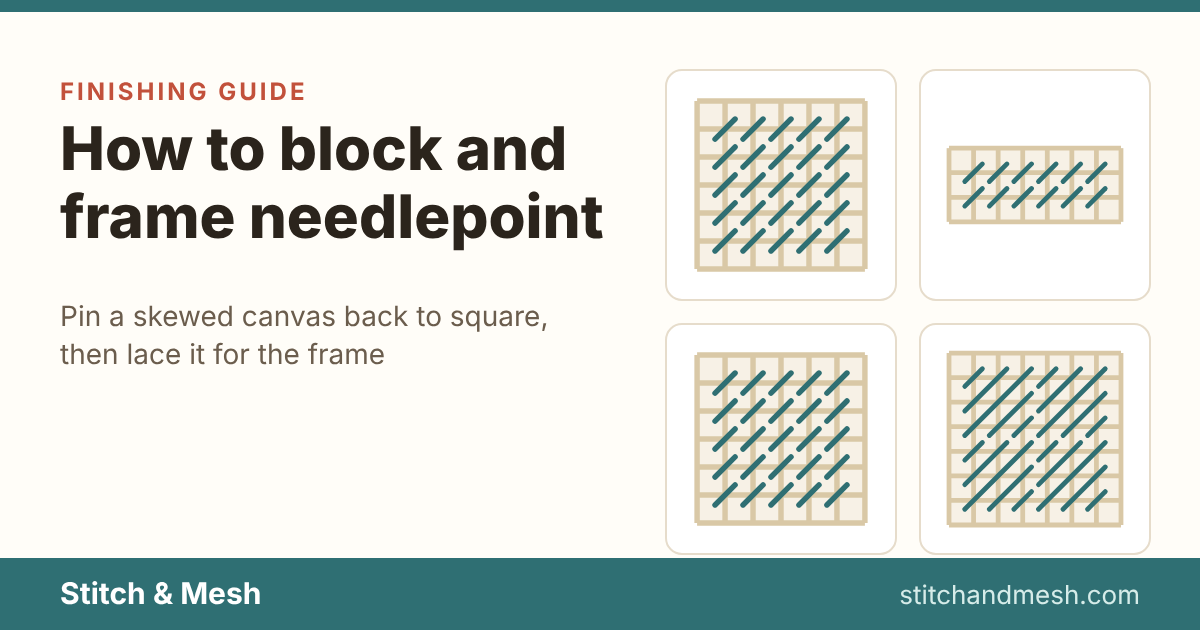
Every tent stitch crosses an intersection on the diagonal, and every one pulls the canvas threads a little in that direction. One stitch does nothing you can see. Thousands of them, all pulling the same way, drag the whole grid into a lopsided parallelogram, so the corners are no longer right angles and the edges of the design bow.
How much a canvas skews depends on how it was stitched. Continental pulls the hardest, because every stitch in a row leans the same way and the long stitches on the back pull with it. Basketweave pulls much less, because its rows alternate and the back forms a woven grid. Long diagonal stitches such as Byzantine and Milanese pull more than short ones. Work held in the hand, where the canvas flexes with each stitch, skews more than work held taut on stretcher bars, and tight tension makes everything worse.
Blocking undoes the skew. The canvas is dampened so the sizing in the threads softens, pinned out so its grid is square again, and left to dry, so the canvas threads set in their corrected position. How to finish needlepoint explains where blocking fits among the other finishing steps. This page is the step-by-step.
What you need to block at home
- A board you can pin into. A purpose-made blocking board works, and so does a sheet of foam insulation board, a cork board or a ceiling tile. It must be bigger than the canvas, flat and able to get damp.
- A square grid. Many blocking boards have a printed grid. On a plain board, rule a grid with a waterproof marker, or lay gridded paper under a sheet of plastic wrap so the ink can't transfer.
- Rustproof pins. Rust stains canvas permanently, so use stainless steel pins, T-pins or a blocking frame with rustproof pins. You'll need plenty: one every half inch to an inch along every edge.
- A spray bottle of plain, cool water, and an old towel.
- A ruler or a set square to check that the corners are right angles.
Check for colorfastness first
Water can make some threads and canvas paints run, and a bleed into the background can't be undone. Test before you wet anything.
Dampen a white cotton swab or a scrap of white cloth and press it firmly on a patch of bare painted canvas in the margin, then on the end of each thread color, especially reds, dark colors, hand-dyed and overdyed threads, and silks. If any color comes off on the white, don't wet-block the piece. Stop and take it to a professional finisher or framer, who can decide whether it can be blocked at all.
If everything passes, block with as little water as will do the job. A damp canvas is enough; a soaked one takes far longer to dry and gives any doubtful dye more time to move.
How to wet-block a canvas
Lay the board flat and put the canvas on it face down if the stitching is raised and you want to protect it, or face up if you want to see the design lines while you pin. Face up is easier the first time.
Pin it square
- Mist the canvas on both sides until it is evenly damp and limp, not dripping. A badly skewed canvas can sit under a damp towel for a few minutes to soften.
- Line the top edge of the stitched area up with a line on the grid. Pin it along that line, in the bare canvas margin, never through the stitching. Start in the middle of the edge and work out to the corners.
- Pin the bottom edge next. Ease the canvas toward the grid line, pulling gently against the direction of the skew, until the canvas threads run straight and parallel to the grid. Pin from the middle outward.
- Pin the two sides the same way, again from the middle outward, until all four corners are right angles. Check with the set square, and measure both diagonals of the stitched area: when they are the same length, the piece is square.
- Add pins until the edges run straight between them, without scallops.
Don't try to win in one pull. If the canvas fights back hard, get it as close to square as you can without straining the threads, let it dry, then mist and pin it again. A severely skewed canvas sometimes takes two or three rounds.
Let it dry completely
Leave the canvas pinned, flat and undisturbed until it is dry all the way through, including the thick stitching and the canvas under it. That can take a day or more, depending on the thread, the humidity and how damp the piece was. Keep it out of direct sun and away from heaters, which dry the surface before the inside.
Don't unpin it early. A canvas unpinned while it's still damp can spring back toward its old shape. When you're sure it's dry, take the pins out and check the corners again.
When you can skip blocking
If the stitched area is already square and flat, there's nothing to fix. That's often the case for a canvas stitched on stretcher bars or a scroll frame, mostly in basketweave, with even tension. Lay it on the grid and look: if the canvas threads run along the lines and the diagonals measure the same, leave it alone. Skip it too when a finisher or framer will be blocking the piece anyway.
When to stop and use a professional framer or finisher
- A thread or the paint failed the colorfastness test.
- The piece is valuable, old or sentimental, and a mistake would be hard to live with.
- The canvas is very large, or so skewed that it won't come square after a couple of rounds.
- It has beads, metallic threads, ribbon or other embellishments that don't take well to water.
- It's going to be made into something sewn, such as a pillow or a stocking, and the finisher will block it as part of that job.
If a professional is finishing or framing the piece, ask before you block it yourself. Many include blocking in their price, and some charge for it separately. Ask whether they want the canvas sent unblocked, and never trim the bare margin before it goes: they need it to pin, lace and sew.
How to frame a blocked canvas
A framed piece has to stay square for years, so the canvas is mounted on a board before it goes in the frame. At home, the standard method is lacing. It holds the canvas under even tension, it doesn't put glue on the stitching, and it can be undone.
Lacing over foam board or a mount
- Cut a piece of acid-free mount board or acid-free foam board to the size the stitched area will show in the frame. Some framers add a padding layer of acid-free batting or felt on top so the stitching sits softly.
- Lay the canvas face down, center the board on it, and fold the bare margins over the back. Line the canvas threads up with the edges of the board, and pin through the canvas into the edges of the board to hold everything straight.
- With strong thread, such as buttonhole thread or crochet cotton, lace the top margin to the bottom margin in a zigzag across the back, a stitch every inch or so. Start in the middle and work out, leaving long tails.
- Tighten the lacing a little at a time from the middle outward, checking the front, until the canvas is smooth and the threads run straight along the edges. Then tie off.
- Fold the corners neatly, lace the two side margins the same way, and take out the pins.
Lacing needs enough bare canvas to wrap around the board, which is one more reason to leave the margin alone until you know how the piece will be mounted. If you're cutting canvas for a new project you plan to frame, the mesh and canvas size calculator adds a margin to every side.
Avoid glue, double-sided tape and staples through the stitching. Adhesives can stain and yellow with age, and they make the piece impossible to remount.
Glass, mats, and leaving space for the stitching
Glass keeps dust and fingers off the piece, but it shouldn't touch the thread. Glass pressed against stitching flattens the texture, and it can trap moisture against the fibers. Keep a gap with a mat, or with spacers hidden in the frame's rebate. A mat also gives the piece a border of breathing room. Some stitchers frame textured pieces without glass and dust them gently instead. If the piece will hang in a bright room, ask a framer about glazing that filters ultraviolet light, which slows fading.
Make sure the canvas is fully dry before it goes behind glass, and use acid-free materials for everything that touches it: the mount, the mat and any backing.
Framing is only one finish. For other end uses, see how to finish a needlepoint ornament and needlepoint pillows. If you're still at the start of a project, how to needlepoint covers the basics, and stitching on bars means less to fix later.
Questions
Do I need to block needlepoint before I frame it?
Only if it's out of square. Lay it on a grid: if the canvas threads run straight and the diagonals of the stitched area measure the same, it can go straight to lacing. If it's skewed, block it first, because a frame won't pull it straight.
Can I block needlepoint myself?
Yes, if the threads and paint pass a colorfastness test. You need a board you can pin into, a grid, rustproof pins and a spray bottle. Take valuable, embellished or badly skewed pieces, or anything that bleeds, to a professional.
How long should a blocked canvas dry?
Until it's dry all the way through, which can take a day or more depending on the thread, the humidity and how damp it was. Leave it pinned until then, because a canvas unpinned while damp can spring back out of square.
What if the paint or thread is not colorfast?
Don't wet it. Stop and ask a professional finisher or framer. They may block it by another method, or advise mounting it as it is. Water can't be taken back once a color has run.
How do you frame needlepoint at home?
Block it square, then lace it over acid-free mount board or foam board: fold the margins to the back and lace top to bottom, then side to side, with strong thread. Put it in a frame with a mat or spacers so the glass doesn't touch the stitching.